A Gallery Visit Built Around One Question
A gallery visit built around one question helps you notice how labels, lighting, spacing, and sequence shape a work—and leave with a sharper impression.
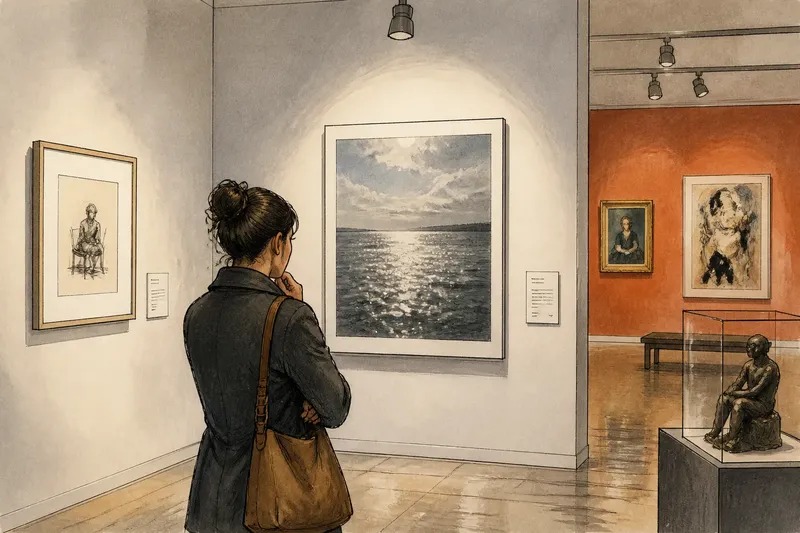
A gallery visit built around one question can turn a room of separate objects into a connected encounter. Choose something observable, such as how the display directs attention, then follow that question through the labels, lighting, spacing, and sequence without trying to account for everything at once.
This approach is not a test of expertise or a demand to extract a single correct meaning. It gives your attention a thread to hold while leaving room for the work to surprise you. The question concerns how the work reaches you, not just what it depicts.
What question should guide a gallery visit?
Pick a question that can be investigated by looking at the work and its presentation. “How does this display tell me where to look first?” is more useful than “What does this all mean?” because it invites you to notice particular choices rather than search for a definitive answer.
A strong question is open enough to follow across several works, but narrow enough to keep in mind. Consider one of these:
- What makes one work seem more prominent than its neighbors?
- How does the distance between works affect the way I compare them?
- What do the labels explain, and what do they leave for me to infer?
- Does the room encourage a particular order of looking?
- How does a frame, plinth, screen, or case change my sense of the work?
Choose one question before you enter, or after the first work has caught your attention. If it depends on facts you cannot readily observe, revise it: “What was the artist’s intention?” may lead you to rely on a label, while “What details make this seem deliberate or accidental?” keeps you looking.
How should I choose a question once I am inside?
Let your first response offer a starting point, not a verdict. A work may seem quiet, theatrical, intimate, or difficult at first glance; ask what in the room helps produce that impression. A high-mounted photograph, a narrow passage, or a label placed beside rather than beneath an object can become part of the inquiry.
Spend a short moment with one work before deciding that your question fits. Notice where your eyes land, what you read first, and whether you move closer or step back. If the question produces only a yes-or-no answer, make it more precise: instead of asking whether the room feels crowded, ask which relationships between the works become harder to see when they are close together.
It is fine to change your question. A gallery is not a worksheet, and a question that sounded promising at the entrance may become less useful after you meet the work. Keep the change deliberate: identify what you noticed, then shape a question that can follow that observation through the rest of the room.
How can I follow the question through the room?
Move through the space at a pace that lets you compare rather than merely accumulate. At each work, look first without reading, then inspect the label and display, and finally look again. The second look may disclose whether the text sharpened your attention, redirected it, or introduced an idea that the object itself does not make visible.
Use the room’s physical details as evidence. Notice sightlines from the doorway, the height of a work, the direction of a spotlight, the color of a wall, the placement of a bench, or the way a doorway frames the next space. These details do not prove what a curator intended; they help you describe the conditions under which you are seeing.
Compare works without assuming that they were meant to be read as a pair. A shared wall, similar size, or common material may invite comparison, while a gap or change of room may interrupt it. Ask what the arrangement makes easy to notice and what it asks you to supply for yourself.
Imagine you enter a room where a small drawing hangs beside a large, brightly lit photograph. You ask, “What makes one work claim attention before the other?” After looking from the doorway, reading both labels, and returning to the drawing, you might notice that size and brightness pull your eyes toward the photograph, while the close spacing makes the drawing feel like a reply. That is an observation about this encounter, not proof that the display has one intended meaning.
If the gallery is busy, adapt the method rather than waiting for perfect solitude. Look from a clear position, step aside when others need access, and return if the view changes. Do not touch an artwork or equipment to test how it is made or displayed.
What should I look for in labels and display choices?
Labels offer a second kind of evidence, but they are not a substitute for looking. Note whether a label gives a title, material, date, process, or context, and then ask how that information changes your attention. A material description may lead you to inspect a surface; a brief contextual note may make a familiar image feel less straightforward.
Also notice where the information appears and how much space it receives. A long panel at the entrance can frame the room before you see its works, while a compact label beside one object may keep the information local. If the text is difficult to read or the gallery is crowded, skip it for now and return when convenient; the question can remain grounded in what you can see.
Display choices include more than wall placement. A sculpture on a plinth asks for a different viewing position from a work installed at floor level; a video screen can create a pause, and a protective case can affect how closely you approach. Treat these arrangements as part of the viewing situation, while allowing for practical reasons—such as conservation or access—that may not be apparent in the room.
How do I leave time to reconsider my first impression?
Do not spend the entire visit chasing new observations. Before leaving the room, return to one work that shaped your first response and look at it again with your question in mind. Ask whether the initial impression still fits, has become more specific, or now seems incomplete.
A brief note can preserve the difference between first and later impressions. Write down one concrete detail rather than a broad judgment: “the label was visible before the painting” gives you something to consider later, while “the room was confusing” closes the question too soon. If writing interrupts your attention, keep the note in mind and record it after you step out.
Leave a little unstructured time at the end. Walk back through the room without forcing every work into your question. You may notice an exception that changes the pattern, or find that the question belongs to only part of the display. That limit is useful information, not a failure to finish the task.
How should I record what I noticed?
Record observations in language that separates what you saw from what you inferred. “The central work has more light around it” describes a visible arrangement; “the curator wants it to dominate” proposes an intention you may not be able to confirm. Keeping those statements distinct makes your account more precise and lets another visitor disagree without disputing what was present.
If photography is permitted, follow the gallery’s rules and use a photograph as a reminder, not as a replacement for looking. A quick note can identify what the image cannot preserve: the route from one work to another, the sound of a video, the view from a doorway, or the way nearby visitors alter your position. Where photography is restricted, a written description is enough.
For a useful record, capture three things:
- Your question, in the exact words you used.
- One display detail you observed directly.
- How your first impression changed, or why it stayed the same.
Keep the record modest. The aim is to retain a line of attention you can revisit, not to produce a complete account of the exhibition.
Can I visit with someone else and keep the question useful?
Yes, if you treat another person’s response as another perspective rather than an answer key. Agree on one question, look separately for a while, and then compare what each of you noticed. You may attend to different details because you stand in different places or bring different expectations to the work.
Ask each other for observations before interpretations. “What did you notice first?” can open a conversation about scale, text, sound, or movement. “What is it supposed to mean?” can narrow the exchange too early, especially when neither visitor has enough context to settle the question.
It can also be helpful to keep different questions. One visitor might track how labels shape a reading, while another follows how the room’s sequence changes their sense of time. Share the questions at the end and notice where they overlap; the point is attentive conversation, not agreement.
What if the question stops fitting the exhibition?
Let the question become smaller or change direction when the room gives you a reason. A display focused on sound may not offer much to inspect through a question about wall spacing, while a series of objects behind glass may make access and distance more noticeable. Adjusting the question keeps your attention responsive to the works actually present.
Sometimes the exhibition itself does not offer enough evidence for the question you brought. You can name that boundary plainly: the arrangement is visible, but its purpose is not. Avoid filling the gap with a confident story about the artist, curator, or institution.
A gallery visit built around one question works best when the question remains a companion rather than a rule. Bring it back to the room, test it against what you can observe, and let a changed impression remain changed. Near the end, revisit the first work once more; the detail that now stands out may be the most useful thing you carry beyond the gallery.