The Brief Is a Boundary, Not a Blueprint
A creative brief sets shared scope without dictating the finished work, helping collaborators make clear choices while preserving room for form and surprise.

A creative brief works best when it fixes the project’s purpose and practical limits while leaving artistic decisions open. That distinction gives collaborators a shared starting point without pretending the finished work is already known.
It matters whether you are commissioning an illustration, shaping a live event, developing an audio piece, or asking a team to create a public-facing campaign. Treat the brief as a boundary, and it can keep a project coherent without making every result predictable.
Name the work that needs to happen
Before writing instructions, state the need behind the assignment. “Make something engaging” offers little direction; explaining what the audience needs to understand, feel, or do gives the team a meaningful problem to address.
Keep the purpose separate from a proposed solution. “Help first-time visitors feel welcome at the neighborhood arts center” describes an aim. “Produce a cheerful poster with three photographs” already selects a medium and visual approach, which may or may not serve that aim.
Say you are commissioning a short sound piece for a library’s listening room. The starting point is that visitors need a gentle invitation to explore local oral histories. The brief can establish that purpose and setting while leaving open whether the piece uses narration, environmental sound, music, or a combination.
Write the need in plain language, then ask whether someone unfamiliar with the project could explain it back to you.
Make the creative brief’s scope explicit
Scope is the part of a brief that should be firm. It identifies what the commission includes, what it excludes, who it is for, where it will appear, and which practical conditions shape its use.
For a performance, scope might identify the intended audience, venue type, available cast, accessibility needs, and whether the work is a standalone piece or part of a larger program. For an illustration, it might specify the publication context, audience, delivery formats, and required subject matter.
Separate requirements from preferences. A requirement is necessary for the work to serve its purpose or fit its setting. A preference reflects a current inclination that may be reconsidered if the creative team offers a stronger way to meet the need.
- Purpose: Check whether the brief says what the audience should understand, notice, or experience; if it does, keep that aim, and if it does not, clarify the need before commissioning work.
- Audience: Check whether the intended audience and its context are named; if they are, use them to guide choices, and if they are not, ask the commissioner to define them.
- Use: Check where and how the work will be presented or circulated; if the setting is confirmed, include it, and if it is uncertain, mark it as an open question rather than treating a guess as a requirement.
- Constraints: Check which confirmed limits affect content, access, format, or coordination; if a limit is binding, state it plainly, and if it is only preferred, label it as a preference.
- Exclusions: Check whether adjacent work falls outside the commission; if it does, name it, and if the boundary is unclear, ask the commissioner to distinguish included work from additional requests.
- Approval: Check who can resolve questions and confirm scope; if one decision-maker is authorized, name that person or role, and if authority is shared or unclear, agree on a decision route before work proceeds.
Each item should affect the work’s purpose, audience, use, or workable limits. If it does not, it may be better handled in a conversation later.
Distinguish boundaries from preferred solutions
A boundary protects the conditions that make a commission useful. A blueprint specifies the route to the finished work. “The message must be legible in a busy station” leaves room for visual invention, while “use a red border and a large central photograph” prescribes a particular look.
When you catch yourself naming a choice, ask why it matters. If the answer points to a genuine need, such as legibility at a distance, write down the need. If it reflects taste, identify it as a reference or preference rather than a rule.
References can still help. A sample image, recording, or passage may communicate tone more clearly than an abstract adjective, but explain what it is meant to convey: restraint, pacing, warmth, or the way it addresses an audience. Without that explanation, collaborators may imitate surface features that were never essential.
Keep the brief open where creative judgment belongs, while being exact about conditions the work cannot ignore.
Set decision rights before inviting ideas
Creative freedom is easier to use when people know where they can make decisions and where they need agreement. Clarify who shapes the work, who responds to it, who has final approval, and which decisions require a conversation with the commissioner.
You do not need to list every possible choice. Identify decision areas that could change the commission’s scope: a shift in audience, a new venue, additional deliverables, or a major change in subject. A different color palette, narration style, or arrangement may remain a creative choice within the agreed work.
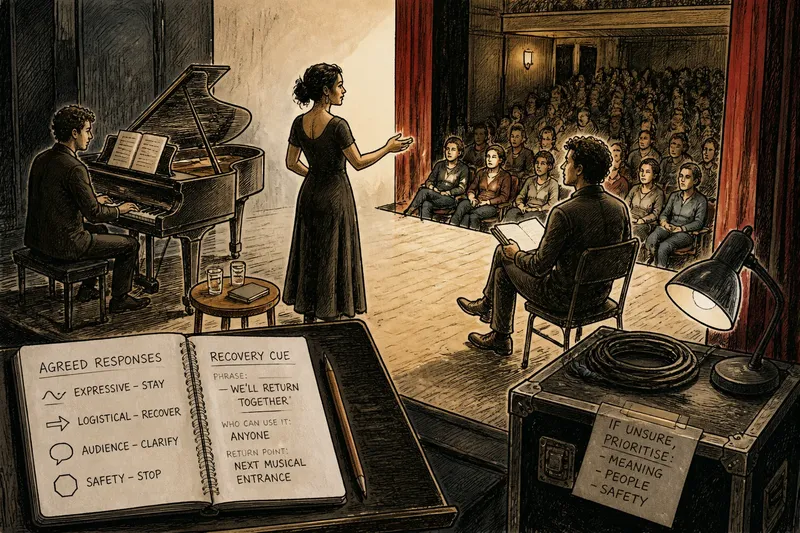
Imagine a small theater asks for a short piece for an existing evening program. The team agrees that the audience, venue, and running context are fixed, while tone, staging, and sound are open. If the creative lead proposes a quiet, audience-facing performance instead of a conventional scene, the proposal can be judged against the purpose and setting rather than rejected for departing from an unspoken expectation.
Make the decision-maker and the route for resolving scope changes clear before work begins.
Leave room for collaborators to propose the form
A brief should let the people doing the work bring their expertise to bear. Describe the desired audience experience and real constraints, but leave the medium or treatment open when the commission does not require a particular one.
If you need an image to make complex information approachable, you may not yet know whether the best answer is a single illustration, a sequence of panels, or a diagram with hand-drawn elements. State the communication need and conditions of use, then invite a proposal about form.
Room to propose does not mean asking collaborators to guess what counts as success. Name qualities in observable terms. “The audience should be able to identify the next action” is clearer than “make it powerful”; “the opening should orient listeners to the place and speakers” gives more usable direction than “make it cinematic.”
When reviewing a proposed approach, return to the agreed purpose, audience, and scope. Ask how the choice serves them before asking whether it matches an image you had privately imagined.
How should you resolve open questions and changes?
What belongs in the brief rather than a reference board?
Put binding requirements, the project’s purpose, and confirmed constraints in the brief. Use a reference board for visual, tonal, or material cues, and explain which qualities matter so examples do not become accidental specifications.
What if the creative team proposes a different medium?
Compare the proposal with the audience need, intended use, and scope before deciding. If the medium is not a fixed requirement and the alternative serves the commission, treat it as a creative option rather than a change by default.
What should happen when the scope changes?
Identify what has changed: audience, deliverables, setting, timing, or another agreed condition. Then confirm who can approve the change and what it means for the work before asking the team to proceed on a new assumption.
How can a brief leave room for surprise without becoming vague?
Be precise about purpose, boundaries, and decision rights, but avoid dictating choices that are not necessary to the commission. A collaborator should be able to explain what must remain true and where an original approach is welcome.
Review the brief before sharing it
Read the draft as a collaborator would, looking for places where a practical limit could be mistaken for a stylistic command or a preference could be mistaken for a requirement. Replace broad adjectives with descriptions of the audience experience or the work’s use.
Then check that the scope can be repeated in a few plain sentences: what the work is for, who it serves, where it will appear, what must be respected, and who can decide unresolved questions. If those points are hard to state, the project may need a conversation before it needs more wording.
Where a brief depends on a label, manufacturer instructions, or local rules—for example, in a commissioned installation or a work used in a regulated setting—confirm those conditions with the relevant source or a qualified professional. Keep that guidance distinct from creative preferences.
A good creative brief is neither an empty invitation nor a finished design disguised as instructions. It sets shared scope so collaborators can make informed choices about form and gives everyone a fair way to discuss whether those choices serve the work. Before sending the next creative brief, underline each sentence that dictates a solution and ask whether the project truly needs that choice fixed.