From Manuscript to Printed Book: The Work Between
From manuscript to printed book, each handoff changes how readers meet the work. See how editing, design, proofing, and production fit together.
A finished manuscript is not yet a printed book: it still needs decisions about language, structure, page design, materials, and the moment it is ready to leave the press. From manuscript to printed book, the work between is a sequence of handoffs, each translating the same text into a form readers can hold and understand.
1. Confirm what “finished” means
Before editing begins, the author and publisher need a shared account of what has been delivered. That may include the manuscript, image files, captions, permissions, acknowledgments, and any notes about unusual formatting. A missing map or an unresolved image credit can interrupt work later, when pages have already been designed around it.
This is also the point to distinguish a complete draft from a file ready for editorial review. The latter should have a stable structure and no open questions that would change the book’s premise or major sections. If substantial material remains in motion, it is better to identify that now than to treat later production pages as settled.
Make a brief inventory of every file and outstanding decision before the handoff.
2. Edit for the book’s argument and shape
Developmental or structural editing looks at the manuscript as a whole. An editor may ask whether chapters build in a useful order, whether a subject receives enough attention, or whether a passage belongs in the book at all. These are questions about the reader’s route through the work, not merely its sentences.
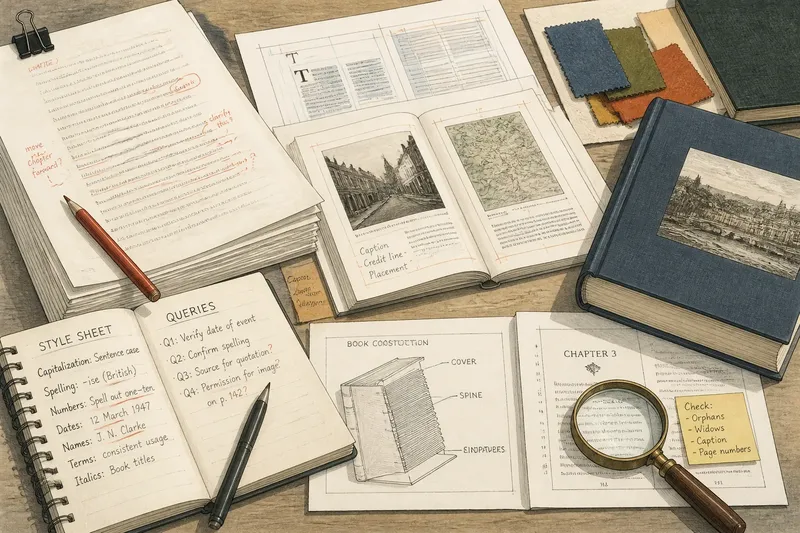
Say an author has a history manuscript whose opening chapter introduces a subject that does not return until much later. The editor might suggest moving a later chapter forward and revising the opening to establish a clearer thread; the visible result would be a more legible progression, while the author still decides what belongs in the book.
Some books need little structural intervention; others need extensive conversation. The point is to settle large-scale choices before copyediting and layout make revision more cumbersome.
3. Copyedit the language and internal details
Copyediting works closer to the line. The editor checks grammar, consistency, usage, and the book’s own style decisions, while also querying unclear passages and details that may need the author’s attention. A style sheet records choices such as capitalization, spelling of recurring terms, treatment of numbers, and preferred forms of names.
Copyediting is not a promise to make every sentence sound alike. Its purpose is to remove avoidable friction while preserving the author’s voice. A query should make the uncertainty visible rather than quietly guess at the author’s meaning.
Authors should resolve queries in a way that leaves a clear record of the decision.
4. Prepare text, images, and permissions for layout
Before typesetting, production staff gather the approved text and the assets that will appear beside it. Images may need captions, credit lines, placement notes, or files suitable for print. Permissions should be tracked alongside the relevant material so that a rights question does not surface after a page has been composed.
The manuscript also needs a consistent handoff format. Clear chapter breaks, marked headings, and unambiguous notes help a designer distinguish actual content from instructions. A stray comment such as “maybe move this” should not be left where it could be mistaken for text.
Where the correct treatment depends on a rights holder, printer, publisher, or local rule, follow the applicable instructions rather than inferring permission from a file’s availability.
5. Design the pages around the reading experience
Book design gives the text a physical rhythm. Trim size, typeface, margins, line spacing, running heads, and chapter openings shape how the page feels and how easily a reader can follow it. A novel, a collection of essays, and an illustrated reference book place different demands on that design.
The designer is not simply decorating a manuscript. A dense page can make a complex argument tiring to read; a short line length may suit one kind of material but interrupt another. Page architecture should support the work’s pace and structure without drawing attention away from it.
Once a design direction is agreed, typesetting turns the manuscript into composed pages. The resulting proof is the first chance to see the words in their intended physical setting.
6. Proof the composed pages, not just the old file
Proofreading catches errors that appear in the designed book: a heading stranded at the foot of a page, a missing line, a caption separated from its image, or a page number that does not match the contents. The proofreader compares the pages with the approved text and checks the composition itself. This is a different task from copyediting, even when the same person may have experience in both.
Authors and editors may review proofs too, but the review should be focused. Late changes can shift pagination, so an adjustment in one place may create a new problem elsewhere. Corrections should be clear, limited to genuine errors or essential changes, and returned through the agreed process.
Read the pages in their designed order, including front matter, captions, and back matter.
7. Check the final production files
After proof corrections are incorporated, the publisher prepares files for printing. A final check confirms that the corrected pages are present, the page sequence is complete, and the cover relates properly to the interior. Print production also depends on technical requirements set by the chosen printer, including file preparation and color handling.
For books with photographs or colored artwork, a digital screen cannot show exactly how ink and paper will render every image. The production team may use a printer’s proof or another approved method to review the output. The relevant decision is not whether the print looks identical to a screen, but whether it is acceptable for the book’s purpose and specifications.
Do not assume a file is print-ready merely because it opens without an error.
8. Approve manufacture and prepare the book to meet readers
Production approval authorizes the printer to make the book from the approved files. Before that point, the publisher confirms the edition’s contents and the details that affect its physical form. After printing and binding, finished copies enter the publisher’s distribution process, where catalog information, stock handling, and delivery connect the object with bookstores, libraries, and readers.
That final transition is part of publishing, not an afterthought. A book needs accurate descriptive information and a clear route into the places where its intended readers look for it. The printed object and its public identity must agree: title, author credit, edition details, and cover should tell a consistent story.
What happens after a manuscript is accepted?
How long does the process take?
Timing depends on the publisher’s schedule, the complexity of the book, and how quickly editorial queries and approvals are resolved. An illustrated title or a manuscript requiring substantial revision may involve different work from a text-led book with settled content.
Who decides the book’s design?
The designer develops the page and cover design in conversation with the publisher, and often with input from the author. The publisher’s production process determines who has approval at each stage, so the roles should be clear before design begins.
Can the author change text after proofreading?
Corrections are usually possible, but late revisions can affect page flow and require another check. The author should distinguish a necessary correction from a preferred rewrite and ask the publisher how late changes are handled.
What is the difference between proofreading and copyediting?
Copyediting addresses language, consistency, and queries in the manuscript; proofreading checks the composed pages for errors and production problems. Both matter because a clean manuscript can still acquire mistakes during layout.
Each handoff protects a different part of the book
The path from manuscript to printed book is not one long polishing session. Structural editing protects the book’s shape, copyediting clarifies its language, design gives it a readable physical form, and proofing checks what the pages actually contain. Production and distribution then carry that approved object toward its audience.
When a publisher or author reaches a decision point, the most useful question is specific: what kind of problem is this stage meant to catch? Keeping that question in view helps preserve the work’s intention while giving each specialist room to do the job the book needs.