Draft, Mock-Up or Prototype: Which Comes First?
Choose a draft, mock-up or prototype by the question you need to answer next, so early creative work reveals what to revise instead of creating busywork.
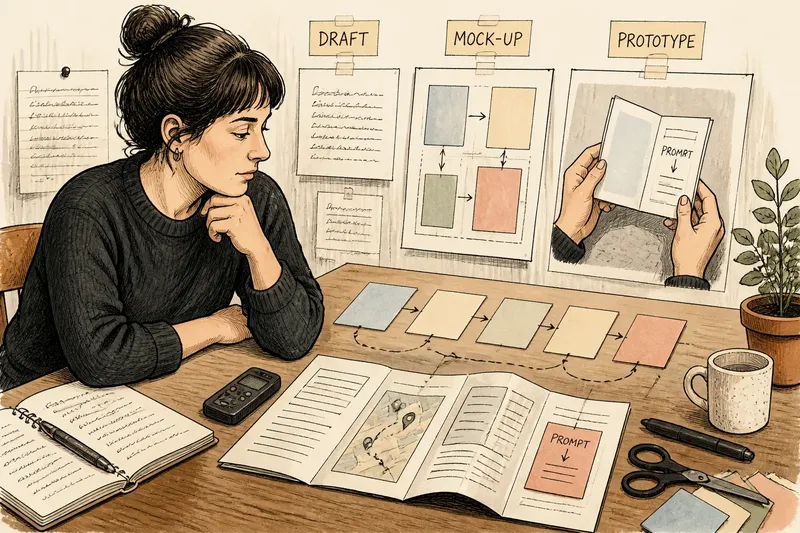
A draft, mock-up, or prototype is useful only if it lets you see something the finished work would hide until too late. For a draft, mock-up, or prototype, begin by choosing the artifact that makes the next decision visible: language, arrangement, or use.
Each working artifact reveals a different kind of information
A draft puts words, sounds, or actions into sequence. It helps reveal whether a scene follows, a lyric develops, or a performance’s transitions make sense.
A mock-up shows how elements sit together without needing to function. A folded zine dummy, a gallery wall diagram, or a slide with image placeholders can reveal hierarchy, spacing, and reading order.
A prototype lets someone encounter an action or interaction. Paper controls can stand in for a digital interface, while a spoken run-through can make timing and transitions observable.
These forms are not stages that every project must follow. Pick the one that exposes the kind of evidence you need to make the next creative decision.
A draft is useful when sequence or language remains unclear
Choose a draft when the unresolved question concerns what is said, sung, or done, and in what order. It can be rough: scene cards, a voice memo, or a plain-text passage may be enough to hear where an idea loses momentum.
If the words read clearly but the page still feels crowded, another prose revision may not help. Lay out the elements instead, and judge their order and visual weight before polishing sentences.
A mock-up makes visual relationships easier to judge
Use a mock-up when the question concerns what a viewer sees and how the parts relate. It can expose a weak focal point, an awkward spread, or a wall arrangement that makes one image compete with another.
A mock-up cannot establish how an object feels to handle or how a visitor responds to an instruction. If those actions matter, make a prototype that supports them rather than adding detail to a static image.
A prototype should reproduce the action under consideration
A prototype does not need to resemble the finished work. It needs to make the relevant action possible: turning pages, choosing a route, moving between performers, or responding to a prompt.
Keep it narrow. If a participatory artwork depends on visitors noticing an invitation, a card with the proposed wording and a simple placement can expose whether that invitation is easy to spot. A complete installation is unnecessary for that question.
Which working artifact should come first?
Should I draft before making a mock-up?
Draft first if the central question is what the work says or how its sequence unfolds. If the words already exist but their placement is uncertain, start with a mock-up instead.
Can a mock-up answer a question about use?
Only if the decision depends on appearance alone. If someone must handle, move through, or respond to the work, a mock-up cannot reveal the experience of that action.
Does a prototype need to work like the finished piece?
No; it needs to support the specific action you want to understand. Paper controls can make a choice visible without running software, for instance.
When should I switch to another form?
Switch when the current artifact has made its question clear and a different uncertainty becomes the next decision. A draft may settle the sequence, leaving a mock-up to clarify composition or a prototype to explore an audience interaction.
A worked example shows how the artifact can change
Imagine you are preparing a short gallery guide with a fold-out map and an optional visitor prompt. You have a draft of the text, but you do not know whether the map’s route is clear or whether the prompt will be noticed.
First, arrange the paragraphs and map as labeled rectangles on a single sheet. If the reading order is hard to follow, move the blocks until the route is visually apparent; that gives you a layout decision without rewriting the copy. Next, fold a paper dummy and place a handwritten prompt where it would appear in the guide. Ask a colleague to handle the dummy and explain what they would do next; if they miss the prompt, revise its placement or wording before preparing finished artwork. The two artifacts answer different questions, so neither needs to become a complete version of the guide.
Use these checks to choose the next artifact
- Check whether the words or actions are still unsettled; if they are, draft a passage or sequence, then decide what needs rewriting after reading it aloud.
- Check whether the order of scenes or sections is unclear; if it is, put them on index cards and rearrange them, then decide which sequence carries the idea more clearly.
- Check whether a page or wall feels visually crowded; if it does, make a rough layout with paper rectangles, then decide whether to move, remove, or enlarge an element.
- Check whether an audience must handle or choose something; if so, make a simple interactive prototype, then decide what instruction or action needs revision based on where the interaction breaks down.
- Check whether a performance transition is uncertain; if it is, rehearse that transition with available props, then decide whether the cue, movement, or timing needs adjustment.
- Check whether the current artifact can answer the question you have named; if it cannot, switch to a form that makes the relevant action or relationship visible, rather than adding polish to the wrong one.
A well-chosen draft, mock-up, or prototype keeps creative effort attached to a decision. Make only the version that can reveal the next useful change, and let its observable result determine whether to revise, continue, or choose another form.