The Myth of the Perfect First Performance
The perfect first performance is a poor standard for live work. Learn which choices to prepare, which variations to accept, and when to pause or adapt.
The perfect first performance is a poor standard for live work: a singer’s breath, an actor’s timing, or a room’s attention will shift from one moment to the next. What matters is not eliminating every variation but deciding which choices must hold and which can move without damaging the work.
That distinction is useful before an opening night, a first concert, a reading, or a public demonstration. A performance can be prepared without being rigid, and it can contain a stumble without becoming a failure. The right approach depends on what is changing, what the audience needs, and what the performers can safely adjust.
Prepare the choices that carry meaning
Some elements are load-bearing. In a play, the audience needs to understand who wants what and why a scene changes direction. In a song, the melody and its phrasing may need to remain recognizable. In a dance, a cue may determine whether performers arrive together or leave space for one another.
These choices deserve rehearsal because they shape the audience’s understanding. The goal is not to make each delivery identical. It is to know what the moment is doing, so an actor can vary the pace while preserving the turn in the scene, or a musician can respond to the room without losing the song’s character.
Mark the moments that would become confusing if altered, then rehearse how to reach them. Leave other details open when a little flexibility can keep the performance present.
Choose your response to the kind of uncertainty
Not every unexpected change calls for the same response. A quiet room, a missed cue, a technical interruption, and a performer’s lost place are different situations. Sorting them before the audience arrives makes it easier to act without treating every variation as a crisis.
- If the variation is expressive: A pause runs longer, a laugh arrives, or a phrase lands with unexpected weight. Stay with it if the next cue remains clear and the work’s meaning holds. This fits performances where timing can breathe, such as spoken word, theater, or acoustic music.
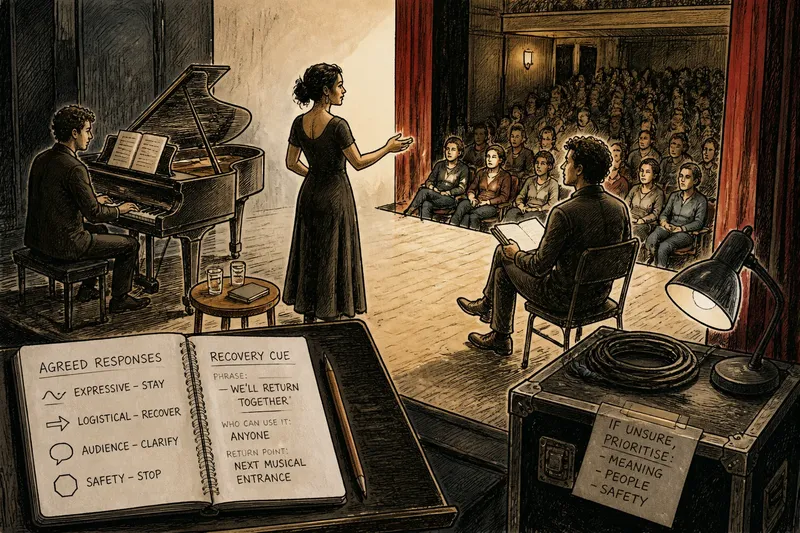
- If the variation is logistical: A prop is not where expected, a page turn is late, or a performer misses an entrance. Use a rehearsed recovery cue or a simple agreed signal. This fits ensemble work, where one person’s improvisation can otherwise leave others unsure what comes next.
- If the variation changes what the audience can follow: A line is swallowed by room noise or an explanation is missed. Slow down, repeat only what is needed, or make the next transition clearer. This fits performances built around language or instructions.
- If the variation raises a safety concern: A set piece shifts, a cable crosses a route, or someone is injured. Stop or change the performance according to the venue’s safety plan rather than trying to preserve the sequence. The performance can wait; people cannot be asked to ignore a hazard.
Say you are reading a short story and a laugh covers the end of a sentence. If the next passage depends on that detail, you can repeat the line plainly before continuing; if it does not, you can let the room settle and move on. The useful decision is based on what the audience needs next, not on whether the moment matched rehearsal.
Use the room without letting it rewrite the work
Live performance includes an audience as part of the conditions. A small room may make a quiet voice feel intimate; a larger or more reverberant space may blur consonants. Attention can gather or drift. These shifts matter, but they do not all require a new interpretation.
Adapt the delivery before changing the work’s central choices. A performer might face the back row more directly, leave a little more air between spoken lines, or wait for a sound to pass. Those adjustments help the existing material reach people. Rewriting a scene or abandoning a musical phrase because one response was subdued is a larger decision and usually deserves more than an immediate reaction.
For a first performance, pick a small number of room-sensitive adjustments in advance. For instance, decide that the speaker may pause until a noisy door closes, but will not add explanatory commentary after every quiet moment.
Keep a recovery path visible
Preparation is not only memorizing the ideal sequence. It also means knowing how to resume after the sequence breaks. A cast can agree on a phrase that signals a skipped passage; musicians can identify a point where the ensemble can rejoin; a presenter can keep a brief transition ready if a visual cue fails.
These recovery paths should be simple enough to remember under pressure. A complicated backup plan can become another performance to manage. Choose one clear signal, identify who can use it, and rehearse the return point so the audience is not left watching the team negotiate.
Make a note of the recovery cue where performers can see it, and keep the cue itself unobtrusive to the audience.
When should you change course during a performance?
Should a performer repeat a line after a stumble?
Repeat it when the audience needs the words to understand what follows, or when the performers need the line as a cue. If the meaning remains clear, continuing may keep the scene’s momentum intact.
Should you improvise when a cue is missed?
Improvise only within an agreed boundary, such as holding a musical texture or repeating a neutral transition. A performer should not invent new plot information or alter another person’s role simply to conceal the miss.
What if the audience reacts differently than expected?
Let the reaction register, then continue toward the work’s next prepared point. A response can shape pace or emphasis, but one quiet or lively moment does not by itself tell you to abandon the performance’s structure.
When is it better to stop?
Stop when continuing would create a safety risk, make the work impossible to follow, or require performers to ignore a serious technical failure. Agree on who can call a pause and how the audience will be addressed before the event begins.
Review the performance without grading its polish
Afterward, separate observations from judgments. “The audience could not hear the final sentence” is actionable; “the whole reading felt bad” is too broad to guide a useful change. Ask performers what they noticed, then compare those observations with the work’s intentions.
Record a few specific decisions for the next performance: clarify a cue, adjust a pause, or keep an unplanned moment that helped the scene. Resist the urge to repair every difference from rehearsal. Some differences are simply the texture of a work meeting a particular room and audience.
The myth of the perfect first performance makes variation look like evidence of failure. A better standard is whether the prepared choices remained legible, whether the team could recover, and whether the audience had a way into the work. Keep that standard close, and each performance can be both carefully made and genuinely live.